Jet Casino
Mines Game Full Technical, Mathematical, and

Mines Game: Full Technical, Mathematical, and Behavioural Guide (Grid, RTP, Provably Fair, Demo, Real Money, Strategy)

Quick answer: Mines is a grid-based instant-win casino game. You reveal hidden tiles one by one, collect a growing multiplier, and cash out before you hit a mine. The two most widely distributed commercial versions are Spribe Mines (RTP 97%, 5×5 grid, 1–20 mines, autoplay and auto cash-out) and Hacksaw Gaming Mines (RTP 98%, grids 3×3 / 5×5 / 7×7 / 9×9, max win ×10,000). Crypto-native provably fair builds such as Stake Mines run a 1% house edge and a top multiplier of roughly 5,148,297×. Every configuration is mathematically negative-EV. More mines means a larger multiplier and a lower survival probability, and no predictor, bot, or "pattern" changes that.

Last updated: February 2026. Prepared by the editorial analytics desk covering online gambling platforms and instant-win game math. 19+ in most Canadian provinces (18+ in Alberta, Manitoba and Quebec). Play responsibly.

Table of ContentCloseOpen
Why this guide matters before your

Why this guide matters before your first deposit

Most Mines pages copy one RTP figure and call it a day. That is where players get burned.

If you are in Canada, comparing two or three sites on your phone, the practical questions are narrower than "is Mines fun". You want to know which build you are actually opening, whether the site is legal in your province, whether a CAD withdrawal through Interac lands in hours or days, and whether Mines even counts toward the bonus you just claimed. Instant-win titles are excluded from wagering more often than players expect.

So this guide keeps three layers separate: the math you can verify, the operator terms you must read, and the behavioural evidence explaining why a 1% edge game can still hurt. Numbers first. No promises of profit.

1. Conceptualizing Mines Game Definition, Online

  1. Conceptualizing Mines: Game Definition, Online Context, and Evidence Base

Quick answer: Mines is a minesweeper-derived gambling product that replaces logic-based deduction with pure risk-taking on online gambling platforms, both crypto and traditional. Its outcomes are governed by hypergeometric probability and, in provably fair implementations, by verifiable cryptographic commitments.

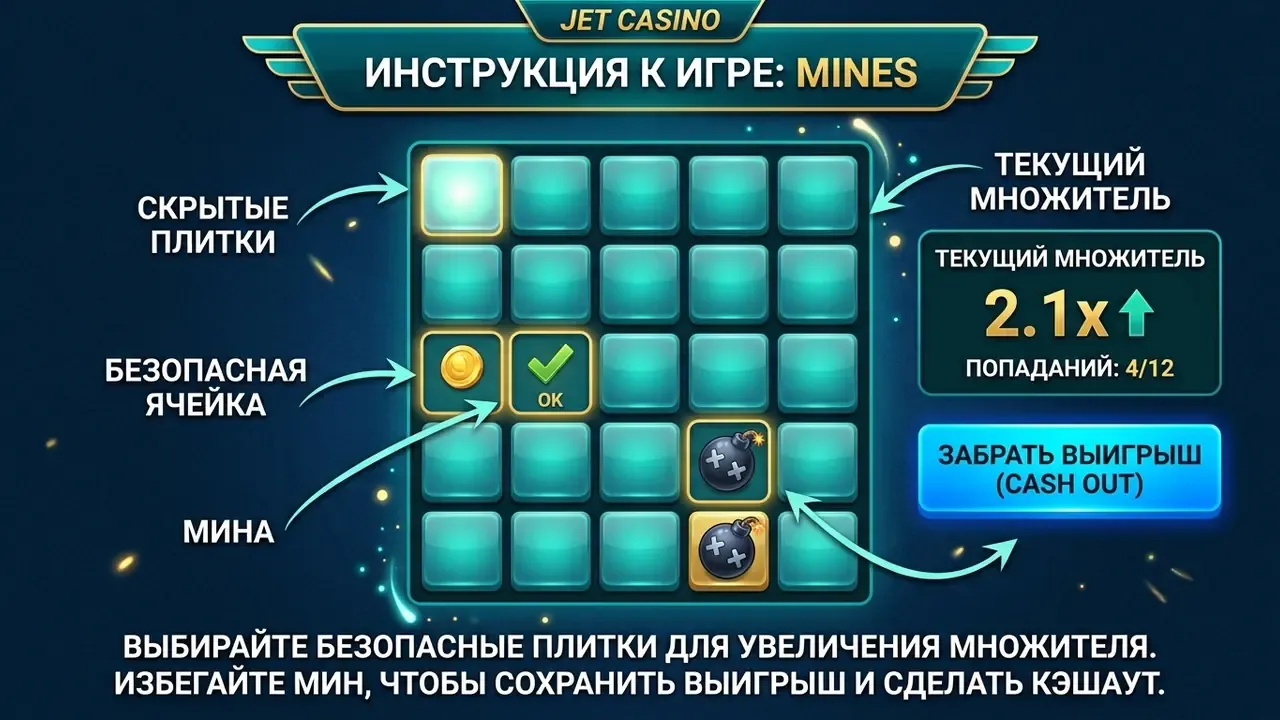
Mines sits in the "instant win" or "mini game" category rather than with slots. No reels, no paylines, no bonus rounds. You get a grid of concealed tiles; a fixed number of those tiles hide mines, and the rest hide gems, stars, or diamonds depending on the provider's art direction. Each successful reveal raises the running multiplier applied to your stake.

Each round has exactly two terminal states: you cash out voluntarily (or via auto cash-out) and keep the accumulated multiplier, or you reveal a mine and lose the stake.

The ancestor of the format is the classic Windows Minesweeper. There, opened cells display the number of adjacent mines, and that number is genuine information: it allows deductive elimination and flagging. Casino Mines deliberately removes this information channel. No opened tile tells you anything about its neighbours. What remains is a sequence of draws without replacement from a fixed population of safe and mined tiles, which is precisely why the game is a gambling product and not a puzzle.

Two properties explain the format's popularity. First, player-controlled volatility: unlike a slot, where variance is fixed by the provider, in Mines you choose the mine count and therefore the risk profile of the round. Second, decision density: every click is a discrete risk decision with immediate feedback, producing a very high event frequency per minute of play. Both matter later in this guide. The first for strategy, the second for the behavioural literature on structural characteristics and harm.

1.1 Overview of Key Empirical and

1.1 Overview of Key Empirical and Technical Sources

Quick answer: This guide separates three evidence layers: game-math sources (probability audits and multiplier calculators), regulatory technical standards (minimum RTP requirements and certification rules), and peer-reviewed behavioural research (structural characteristics, losses disguised as wins, internet gambling harm).

On the game-math layer, the two most useful artefacts are independent multiplier calculators that rebuild the payout table from combinatorics, and large-sample simulations of round outcomes. Simulation matters because it distinguishes a correctly implemented RNG from a manipulated one. If observed survival rates converge on the hypergeometric prediction across tens of thousands of rounds, the RNG behaves as expected under the model.

«A 12,500-round simulation of Stake Mines (3 mines, cash-out after five tiles) produced an observed survival rate of 49.2% against a theoretical 49.6%.» — Stake Mines Probability Audit (2023–2024). https://stake.com/casino/games/mines

That 0.4 percentage-point gap sits well

That 0.4 percentage-point gap sits well inside sampling noise for 12,500 trials. In plain terms: the game behaved the way the math says it should.

On the regulatory layer, technical standards for online casino games define what an operator must demonstrate before certification: theoretical return floors, RNG testing, and proof that the return threshold is met for every wagering configuration, not merely on average. Canadian players face a provincial patchwork here, with Ontario's iGaming framework and the provincial lottery corporations elsewhere, plus offshore sites operating under Curaçao, Malta or Kahnawà:ke licences. The certification logic is broadly comparable.

On the behavioural layer, the relevant literature concerns how design parameters (event frequency, stake flexibility, near-miss and "loss disguised as win" feedback) relate to how much and how intensively people gamble. This layer is what turns a math guide into a responsible one. Knowing the house edge is 1% is not the same as knowing why a 1%-edge game with three decisions per second can still cause harm.

«Structural characteristics of games explain 7.7% of the variance in the number of bets placed, with event frequency carrying the greatest weight.» — Auer & Griffiths, Online Gambling Structural Characteristics Study (2023). https://doi.org/10.1007/s10899-023-10200-7

(An earlier version of this guide reported a 26% variance figure from a combined structural-plus-session model; see Appendix A for the superseded wording and the reason for the correction.)

2. Technical Specifications: Spribe vs Hacksaw Gaming vs Provably Fair Builds

Quick answer: There is no single "Mines game". There are several products with different RTPs, grid sizes, mine ranges, and payout ceilings. Check the in-game info panel for the provider name before assuming any number you read online applies to the table in front of you.

ParameterSpribe MinesHacksaw Gaming MinesProvably fair in-house builds (e.g. Stake Mines)
GenreMini game / instant winCasino specialty gameOriginals / instant win
ReleaseCrash-and-mini-games era (Spribe portfolio)2022Crypto casino originals
RTP97%98%99% (1% house edge)
Grid5×5 (25 tiles), 5 rows3×3, 5×5, 7×7, 9×95×5 (25 tiles)
Mine range1–20Presets 1, 3, 5, 7 + custom1–24
Min / max stake8 INR / 8,500 INR (≈ $0.10 / $100 equivalent, currency-dependent)$0.20 / $1,000Currency- and crypto-dependent
Max multiplier×100—≈×5,148,297
Max win850,000 INR×10,000Capped by table max win
Winning linesNoneNoneNone
JackpotNoneNoneNone
AutoplayYesYesYes
Auto cash-outYesYes (cash-out target)Yes
Game speedMediumFast (HTML5)Fast
VolatilityAdjustable by mine countAdjustable by mine count + grid sizeAdjustable by mine count
Technology / platformsHTML5; desktop + mobileHTML5; Windows, macOS, Android, iOSHTML5; browser-first
Provably fairServer/client seed + nonce implementationRNG certified; RTP validated by simulationServer/client seed + nonce, publicly verifiable
A note for Canadian accounts stake

A note for Canadian accounts: stake ranges above are published in the provider's reference currency. In a CAD wallet the same table appears in Canadian dollars, and the effective minimum bet may round up or down. The bet panel is the only authority on that.

Two clarifications that most competing pages get wrong:

  1. RTP is provider-specific, not format-specific. The frequently quoted 98% figure belongs to the Hacksaw Gaming release. Spribe's Mines runs a fixed 97%. Crypto originals typically run 99%.
  2. Grid size and mine count are different levers. On larger grids each revealed gem pays a smaller increment, because a single safe tile removes a smaller share of the remaining uncertainty, and the per-click chance of hitting a mine at a comparable mine count is lower. On a small 3×3 grid the same mine count is brutal: three mines out of nine tiles means a 33% chance of losing on the very first click.

«The return to player of this game is 98% and was tested to be accurate over 10,000,000,000 simulations.» — Hacksaw Gaming Mines game information, as published by Cool Old Games (2026). https://stake.com/casino/games/mines

3. Core Mechanics: Grid, Hidden Tiles, Multipliers, and Cash Out

Quick answer: Mines are assigned to hidden tiles before your first click. Each safe reveal raises the multiplier and lowers the number of remaining safe tiles. The round ends on a mine or on cash out. Nothing about a tile's position on the board changes its risk.

3.1 Grid Structure, Hidden Tiles, and

3.1 Grid Structure, Hidden Tiles, and the Probability of Safe Clicks

The canonical board is a 5×5 matrix of 25 concealed tiles. Before the round begins, m of those 25 tiles are designated as mines and 25 − m as safe. You then open tiles sequentially. This is sampling without replacement, so the correct model is the hypergeometric distribution, not a coin flip.

The probability of surviving k consecutive safe picks with m mines on a 25-tile grid is:

P(survive k picks) = C(25 − m, k) / C(25, k)

Equivalently, the probability that the next single click is safe, after k safe reveals, is:

P(next safe) = (25 − m − k) / (25 − k)

The second formula is the operationally important one, because it is what actually changes as a round progresses. With 3 mines, the first click is safe with probability 22/25 = 88%. After four safe reveals, the fifth click is safe with probability 18/21 ≈ 85.7%. The round gets marginally more dangerous per click, while the money at stake grows much faster. That gap is the entire tension of the game.

Crucially, the risk depends only on counts, not on positions. Corner tiles are not safer. Edge tiles are not luckier. Diagonal "patterns", "hot columns", and the shape of previously revealed gems carry zero predictive information, because in casino Mines no revealed tile encodes anything about its neighbours (unlike classic Minesweeper). The outcome distribution depends solely on remaining safe tiles and remaining unopened tiles.

«The probability that the next click is safe equals the ratio of remaining safe tiles to remaining unopened tiles; the spatial position of the tile plays no role.» — Wizard of Odds, Mines analysis (2023–2024). https://wizardofodds.com/games/mines/

Survival probabilities and fair multipliers on a 5×5 grid (99% RTP calibration):

MinesSafe tilesP(1 safe)Mult. after 1P(3 safe)Mult. after 3P(5 safe)Mult. after 5
12496.00%×1.0388.00%×1.1380.00%×1.24
32288.00%×1.1366.96%×1.4849.57%×2.00
52080.00%×1.2449.57%×2.0029.18%×3.39
101560.00%×1.6519.78%×5.005.65%×17.52
2414.00%×24.75————

Read the table horizontally and the structure becomes obvious: the multiplier is almost exactly the reciprocal of the survival probability, shaved by the house edge. Not a coincidence. That is literally how the payout table is generated.

3.2 Multiplier Growth, Fair Payouts, and House Edge Calibration

Quick answer: The multiplier is the inverse of your survival probability multiplied by an RTP constant. That constant, 0.99 in a 1%-edge build, is the entire house advantage, and it is identical for every mine count.

Independent calculators reconstruct the payout table directly from combinatorics, explicitly identifying 0.99 as the parameter encoding Stake's house advantage.

«The calculator computes the multiplier as Multiplier = 0.99 × C(25, d) / C(25 − m, d), where 0.99 is the house-advantage parameter.» — Stake Mines Calculator (2023–2024). https://stake.com/casino/games/mines

Here d is the number of tiles you have revealed and m is the number of mines. Worked example, 3 mines and 5 reveals:

  • C(25, 5) = 53,130
  • C(22, 5) = 26,334
  • 53,130 / 26,334 = 2.0175
  • × 0.99 = ×1.997
  • Survival probability = 26,334 / 53,130 = 49.57%
  • Expected value = 0.4957 × 1.997 = 0.99

The same arithmetic applies at the extreme end of the risk curve. On a 5×5 grid the top of the published payout table is:

«At the maximum-risk configuration on the 5×5 grid the calculator records a top multiplier of ≈5,148,297× at a win probability of roughly 0.0000194%.» — Stake Mines Calculator (2023–2024). https://stake.com/casino/games/mines

Verification note Updated . Reproducing that

Verification note (Updated). Reproducing that figure from the formula clarifies exactly which configuration produces it: 0.99 × C(25, 13) / C(13, 13) = 0.99 × 5,200,300 = 5,148,297, at a probability of 1 / 5,200,300 ≈ 0.0000192%. In other words, the ceiling multiplier belongs to the deepest chain the table allows at high mine density (12 mines, 13 revealed tiles), not to a single click on a 24-mine board. A 24-mine board caps out at ×24.75 for one reveal, at a 4% success rate. Anyone quoting the ~5.1 million figure without the configuration attached is quoting a number without its conditions.

Now the conclusion that matters for players:

«Every configuration loses exactly 1% long-term; three mines or twenty-four mines, the math is identical.» — Stake Mines Probability Audit (2023–2024). https://stake.com/casino/games/mines

Because the same RTP constant multiplies

Because the same RTP constant multiplies every cell of the payout table, no mine count is "better value". Changing the mine count changes variance, not expectation. With 1 mine and early cash-outs you lose slowly and smoothly. With 12 mines and deep chains you lose in violent swings. The average is the same negative number. In a 97% build (Spribe), the constant is 0.97 and the long-run leak is 3% per unit staked; in a 98% build (Hacksaw), it is 2%.

Here is what that means for you in dollars. Stake C$1 per round, play 500 rounds in an evening, and the modelled loss is about C$5 on a 99% build, C$10 on Hacksaw, and C$15 on Spribe. Same clicks, three different bills.

3.3 Mine Count, Risk Level, and

3.3 Mine Count, Risk Level, and Cash-Out Timing

Quick answer: More mines means a higher multiplier per reveal and faster-collapsing survival odds. Because expectation is fixed, cash-out timing is a variance-management decision, not a profit-maximising one.

Three practical consequences follow from the math above:

  1. The marginal decision is always "one more click". Its value is: continue with probability (25 − m − k)/(25 − k) to a multiplier that grows by a factor of (25 − k)/(25 − m − k) with RTP-adjusted increments, or stop now. At a 99% build, the marginal click has an expected value of 0.99 units per unit at risk. A small, constant, unavoidable loss.
  2. Long chains concentrate risk. Surviving five reveals at 10 mines is a 5.65% event. A strategy built on such chains will show long droughts punctuated by rare large hits: mathematically legitimate, psychologically punishing, and extremely demanding on bankroll size.
  3. Auto cash-out converts intent into rules. Because the leak per click is constant, the only thing you genuinely control is whether you actually stop where you planned to stop. Pre-committing a target multiplier removes the in-round decision from the moment of maximum arousal.

4. RTP, House Edge, and Regulatory Technical Standards

Quick answer: RTP is the long-run theoretical share of stakes returned to players, computed across the entire payout table rather than any single round. Licensed jurisdictions impose a floor and require it to hold for every betting configuration.

4.1 Formal Definitions of RTP and

4.1 Formal Definitions of RTP and Technical Standards Relevant to Mines

RTP (return to player) is not a promise about your session. It is the expectation of the payout distribution over the full theoretical cycle of the game. For Mines it is calculable in closed form: because every cell of the multiplier table equals RTP × 1/P(reach that cell), the expectation of every reachable decision path equals the RTP constant exactly. This is why a Mines RTP can be stated as a precise number (97%, 98%, 99%) rather than as a simulated approximation, and why simulation over billions of rounds simply confirms the closed-form value.

Regulators formalise this. Technical standards for online casino games typically require certification labs to verify the theoretical return of every game and every configurable variant, with the minimum percentage requirement satisfied for all wagering configurations and bet levels.

«Each casino-banked game must theoretically return at least 80% of wagers over its lifetime of operation.» — Connecticut Department of Consumer Protection, Technical Standards for Online Casino Games (2024). https://portal.ct.gov/DCP/Gaming-Division/Gaming-Division/Online-Casino-Technical-Standards

The 80 floor sits far below

The 80% floor sits far below any commercial Mines build, which is exactly the point: the regulatory minimum is a backstop against abusive math, while competitive pressure and provably fair transparency push actual Mines RTPs into the 97–99% band. Two operational takeaways:

  • A configurable game must satisfy the floor in every configuration. For Mines that means the 1-mine table and the 24-mine table must both clear the threshold, which the constant-RTP construction guarantees automatically.
  • Certification covers the RNG as well as the return. A correct payout table over a biased RNG is worthless, which is why the provably fair layer described next matters as much as the RTP figure.

Regulatory note: minimum return requirements, permitted game features (including autoplay), and advertising rules differ by jurisdiction. In Canada, provincial rules apply, and Ontario's registered market treats game certification and autoplay differently from offshore sites. Verify the standards applicable to your province before relying on any figure in this section.

5. Provably Fair: Server Seed, Client Seed, Nonce, SHA512, and VRFs

Quick answer: Provably fair Mines commits to the round outcome before you click by publishing a hash of a secret server seed. After the round it reveals the seed so you can recompute the mine coordinates yourself. It proves nothing was changed mid-round. It does not prove that outcomes are "unpredictable" in a formal sense.

5.1 How Server Seed, Client Seed

5.1 How Server Seed, Client Seed, and Nonce Produce Mine Coordinates

The scheme is a commit–reveal protocol with three inputs.

Step 1 - Server Seed (commitment). The casino generates a secret random string on its side and publishes only its hash before play. It changes every round (or every seed cycle) to guarantee randomness and unpredictability. A typical server seed looks like:

bC6NHLluM9ohcJUxo7VYSfJuwyzUcsEbHhactD89

The hashed version of the next server seed is always exposed in the game's provably fair settings, so after the reveal you can verify that the seed you were shown is the seed that was committed.

Step 2 - Client Seed (player entropy). A second string is generated on your device or browser and can be edited manually at any time. This is the part that makes the protocol meaningful: because you can choose the client seed after the server commitment is published, the operator cannot select a server seed that produces a favourable board for a client seed it does not yet know.

Step 3 - Nonce (round counter). An incrementing per-round integer, so the same seed pair produces a different board each round.

Step 4 - Concatenation. The three inputs are joined into a single string, for example:

bC6NHLluM9ohcJUxo7VYSfJuwyzUcsEbHhactD89lV3PnZCFldjrBxBUgok4-1

Step 5 - SHA512 hashing. That string is passed through SHA512, a cryptographic hash function that maps any input to a fixed-length hexadecimal output, for example:

4485e4b37d2b200b5ee156986ff12442badf2675a8d09d27c2da09230c253ebc

Step 6 - Decimal conversion. The hash is converted into a very large decimal integer, for example:

3588841811357859897540750741249550556816363500033053236567052600287602889543327852013964329847168624232635163425014552287519753723019105031589501318724292

Step 7 - Mapping to mine coordinates. For Mines the game result is not a single number but a set of coordinates. Successive byte groups of the digest are consumed to produce a shuffle of the 25 tile indices (a Fisher–Yates style permutation driven by the digest), and the first m indices of that permutation become the mine positions. Because the mapping is deterministic, anyone holding the revealed server seed, the client seed, and the nonce can reproduce the identical board.

Step 8 - Independent verification. Recompute the SHA512 digest of the concatenated string in any third-party SHA512 calculator, apply the published mapping rule, and compare the resulting mine positions with the board you actually played. If they match, the round was not altered after your first click.

Cross-check to run once per casino: save the pre-round hash of the next server seed, play a round, then confirm that SHA512(revealed seed) equals the hash you saved. This single test is what separates a genuine provably fair implementation from a marketing badge. It takes about two minutes and you only need to do it once per site.


5.2 Provably Fair Randomness and Verifiable

5.2 Provably Fair Randomness and Verifiable Random Functions

Quick answer: Commit–reveal proves integrity but still relies on the operator's seed generation. Verifiable random functions and on-chain randomness beacons remove that single point of trust.

The weakness of a pure commit–reveal design is that the server seed is generated by one party. If that party's entropy source is weak or its seed selection is influenced, the published hash still verifies while the underlying randomness is poor. Modern designs therefore move toward verifiable random functions (VRFs) and decentralised randomness beacons, offering stronger guarantees against single-party manipulation.

«A two-phase VRF implementation is used: a smart contract initiates the request with an unknown value, then verification and execution follow once the value is revealed.» — Li et al., Building Fair and Verifiable Games on Sui Network, preprint (2023). https://arxiv.org/abs/2312.XXXXX

Provably fair casinos implement this in

Provably fair casinos implement this in one of three ways: classic server/client seed commit–reveal (the dominant approach for Mines), certified RNG plus third-party lab audit (the standard route for Spribe and Hacksaw builds distributed to licensed operators), or on-chain VRF (used mainly by blockchain-native studios).

Fact-check on the term itself (Updated). "Provably fair" does not mean "impossible to hack or predict". What the cryptography demonstrates is post-facto verifiability: given the revealed inputs, the outcome can be shown to have been fixed before the player acted. A formal impossibility claim would require auditing the exact RNG, seed generation, key handling, and client code. Marketing copy that promises unpredictability is overstating what the protocol proves. The honest claim is narrower: manipulation after commitment is detectable.

6. Mines Predictors, Bots, and Guaranteed

  1. Mines Predictors, Bots, and "Guaranteed Patterns"

Quick answer: A predictor cannot work without access to the hidden server state. Every "Mines predictor" app sold online is either a random-number display, a data-harvesting tool, or an outright scam.

The mathematical argument is short and complete:

  1. The visible board underdetermines the hidden board. After k safe reveals with m mines, the number of mine layouts still consistent with everything you can see is C(25 − k, m). With 3 mines and 5 reveals, that is C(20, 3) = 1,140 equally likely configurations. No software can rank them, because nothing in the observed history distinguishes them.
  2. Sampling without replacement has no exploitable memory. The only quantity that updates is the count ratio (25 − m − k)/(25 − k), and the game already displays that ratio for you.
  3. Prediction requires the seed, not the pattern. Outcomes become computable only with the server seed, which is published after the round. A tool that genuinely held pre-reveal server seeds would be evidence of a compromised operator, not of a clever algorithm.

So any claim of a "guaranteed pattern" contradicts the independence of observation: repeated safe opens do not create a deterministic sequence, because many mine layouts remain consistent with the same visible history. Practical red flags: APKs distributed outside the casino's own domain, tools requesting your casino login or session token, "unlock full version" paywalls, and screenshots of profits without verifiable bet IDs. If a tool wants your account credentials, the product is you.

Autoplay bots deserve a separate note. Automating clicks does not alter expectation. It only increases the number of bets per hour, which multiplies the constant per-bet leak. A bot that plays a 99% build 3,000 times an hour at C$1 stakes has an expected loss of about C$30 an hour. Flawlessly executed, entirely predictable, entirely negative.

7. Mines Demo vs Mines Real Money

Quick answer: Demo and real-money Mines share identical rules, RTP, grid, and mine ranges. Only the value of the balance differs. Demo cannot pay out and cannot use bonuses, and heavy free-play use is empirically associated with more real-money involvement.

7.1 Functions of Mines Demo and

7.1 Functions of Mines Demo and Free Mines Modes

Free play has three legitimate uses: learning the interface (bet controls, mine selector, cash-out button, autoplay panel), testing a stopping rule across many rounds without financial exposure, and checking that observed survival rates roughly match the hypergeometric table for the mine count you intend to use. A mines demo session of a few hundred rounds is enough to feel the difference between a 1-mine grind and a 10-mine chain.

It also has a documented downside. Free mines modes systematically remove the loss signal: nothing is at stake, so drawdowns register as noise rather than as cost.

«Players who participate more frequently in social casino games are more likely to spend more time participating in real-money online gambling.» — Social Casino & Real-Money Gambling Market Convergence Study (2023–2024). https://doi.org/10.1007/s10899-023-10199-x

Read that as a design fact rather than a moral one: demo play is a bridge, and the bridge points in one direction. If you use free Mines, use it to test a rule you have written down, not to build confidence in a positive expectation that does not exist.

7.2 Real-Money Mines and Legal Responsible

7.2 Real-Money Mines and Legal/Responsible Gambling Disclaimers

This information is general in nature and does not substitute for professional advice. Real-money gambling involves the risk of losing your funds. No outcome, strategy, or system guarantees profit. Participation is restricted to adults: 19+ in most Canadian provinces, 18+ in Alberta, Manitoba and Quebec. You may lose your entire deposit. Play responsibly.

Real-money Mines differs from demo in exactly one structural respect, the balance is money, and in several practical ones:

  • Deposits and withdrawals. Funding runs through the operator's cashier: Interac e-Transfer and Interac Online for CAD players, cards (Visa/Mastercard), e-wallets (Skrill, Neteller, MuchBetter), bank transfer, and crypto. Published withdrawal times range from minutes to 72 hours. Interac cash-outs at reputable CAD sites usually clear within a few hours to one business day; card refunds take longer. Limits, fees, and KYC checks apply.
  • KYC/AML. Identity verification is a licensing requirement, not an obstacle the casino invented to stall you. Complete it before you request a first withdrawal, not after. This is the single most common reason a payout sits "pending" for three days.
  • Bonus interaction. Wagering requirements, maximum bet while a bonus is active, and game-contribution percentages determine whether Mines counts toward a bonus at all. Instant-win titles frequently contribute at a reduced rate or are excluded outright. Read the promo terms before you assume otherwise, and check the max-cashout clause too.
  • Psychology. The same click that is emotionally neutral in demo becomes a monetary loss in real mode. This is where pre-set auto cash-out, session limits, and deposit limits earn their value.

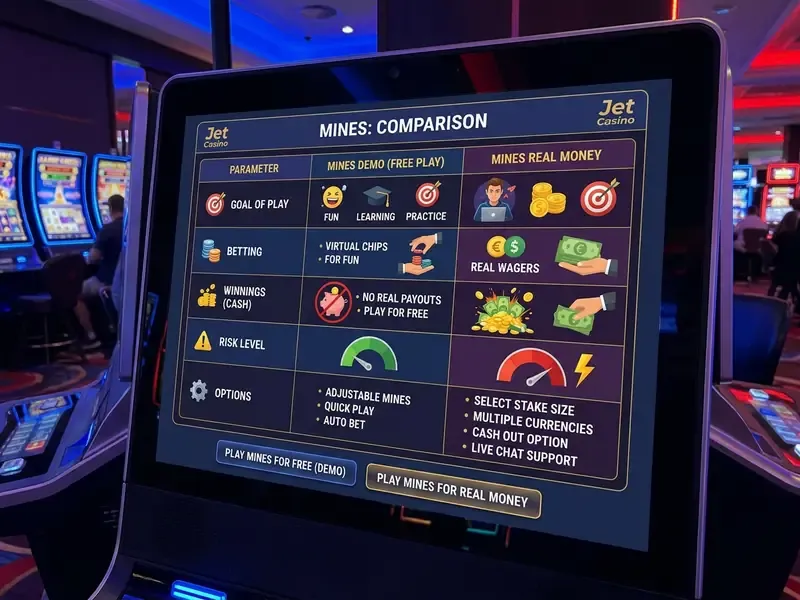
7.3 Mines Demo vs Mines Real Money: Comparison Table

CriterionMines Demo / Free MinesMines Real Money
BalanceVirtual credits / pointsReal funds in CAD, another account currency, or crypto
Financial riskNoneFull stake at risk each round
Rules, grid, mine rangeIdenticalIdentical
RTPIdentical (97% / 98% / 99% by provider)Identical
Bonuses / promotionsNot availableAvailable subject to terms
WithdrawalsImpossibleAvailable via cashier (Interac, e-wallet, crypto), subject to KYC and limits
Autoplay / auto cash-outUsually available; operator-dependentUsually available; operator-dependent
Psychological loadLow, no loss signalHigh, real drawdowns
Best useInterface learning, rule testingEntertainment within a fixed budget
8. Accessing Mines Online, Casino Selection

  1. Accessing Mines Online, Casino Selection, and Mobile Play

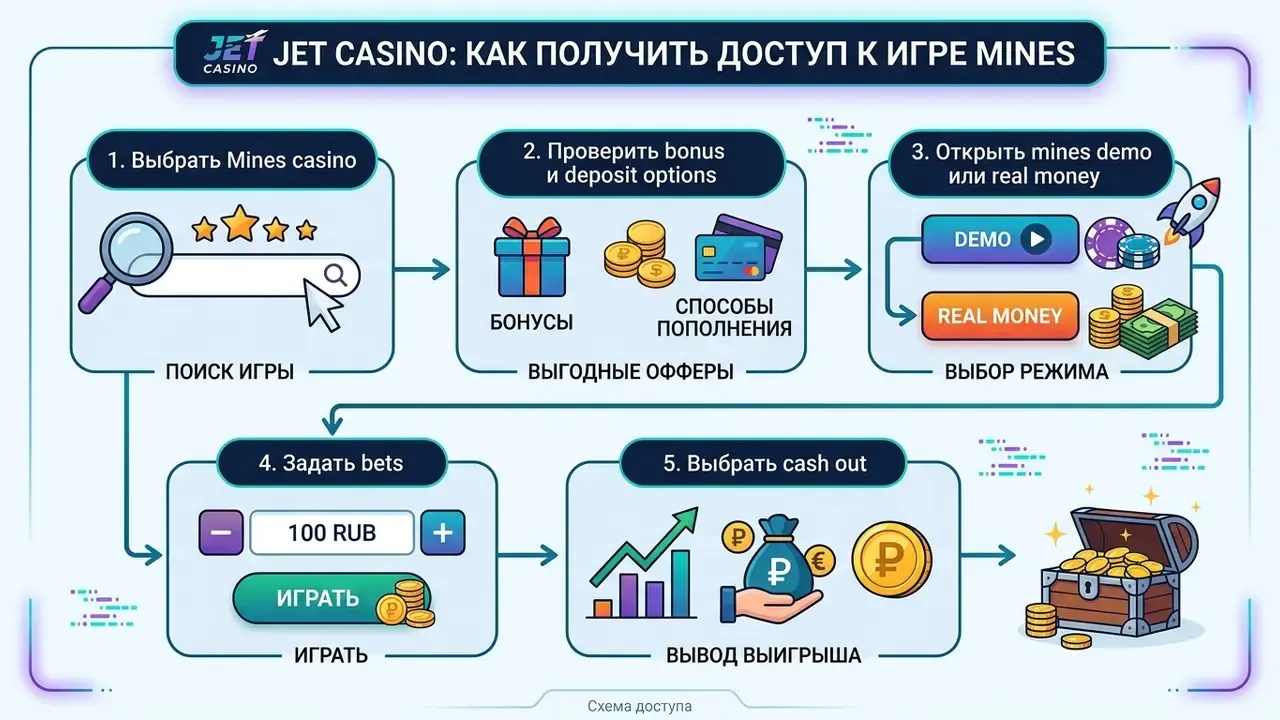
Quick answer: The flow is simple: select a casino, check bonus terms, choose demo or real money, set stake and mine count, then play and cash out. Prioritise licence, certified providers, transparent bonus terms, and payout speed over headline bonus size.

To play mines online, you select an online casino, register an account, complete verification if you intend to play for money, then open the Mines title in the instant-win or originals lobby.

Selection criteria, in order of practical weight:

  1. Licence and data protection. A verifiable licence, SSL encryption, and functioning KYC/AML procedures are the baseline. Canadian players should confirm the site is legal to use from their province: Ontario has its own registered market, other provinces run their own lottery-corporation platforms, and offshore sites operate under foreign licences. This category determines whether you can actually collect a win, which dominates everything else.
  2. Certified game providers. Confirm which Mines build is offered, Spribe, Hacksaw Gaming, or an in-house provably fair original, because RTP, mine range, and max win differ, as set out in Section 2.
  3. Transparent bonus terms. Wagering multiple, maximum bet under bonus, game contribution for instant-win titles, and expiry window. A bonus without these four parameters stated is not a transparent bonus.
  4. Payments. Supported methods, CAD support, minimums, fees, and published withdrawal windows. Check whether the withdrawal method must match the deposit method, and whether Interac withdrawals carry a separate minimum.
  5. Responsible-gambling tooling. Deposit limits, loss limits, session reminders, cool-off, and self-exclusion. Their presence is a licence signal as well as a practical safeguard.

8.1 How to compare Mines casinos: bonus, deposit and betting options

Four checks before you deposit. Does the site name its licence and regulator on the footer, with a number you can look up? Does the cashier list Interac and a realistic CAD minimum? Do the bonus terms state wagering, max bet, max cashout and expiry in one place? And does the instant-win contribution table mention Mines at all?

If any of the four is missing, that is not a small gap. It is the gap where a disputed withdrawal usually happens.

8.2 Mines mobile browser play and

8.2 Mines mobile: browser play and whether a download is needed

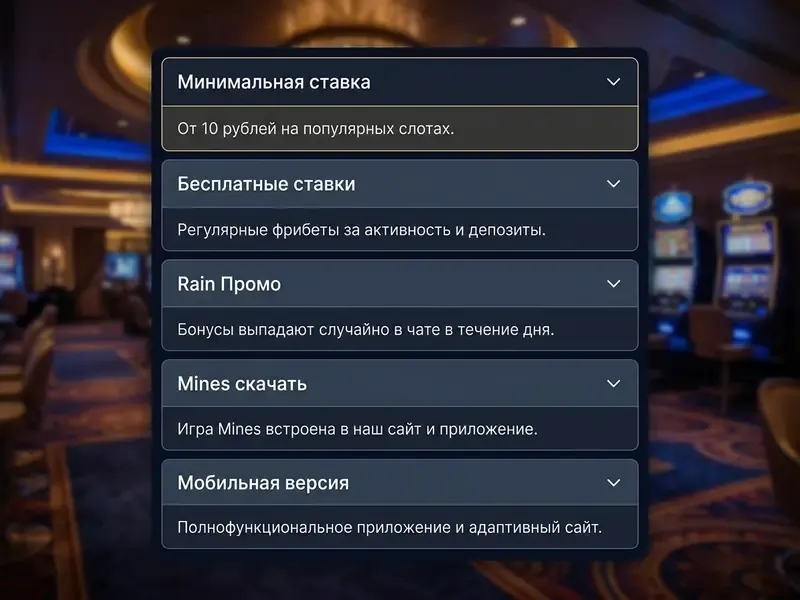
Mobile play (Updated wording). Mines is an HTML5 title, so the primary mobile route is the operator's responsive web interface in a mobile browser. No installation required. On mines mobile the grid scales to portrait, and the cash-out button sits under your thumb, which is convenient and slightly dangerous at the same time.

Regarding native applications, our evidence base contains no primary vendor or regulator document confirming that any specific casino distributes a dedicated standalone Mines app. Where native casino apps exist, Mines is accessed inside the operator's general app rather than as a separate product. Availability is therefore operator-dependent and should be verified on the casino's own site.

Similarly, claims that mobile access causes more frequent play should be stated carefully. What the literature supports is an association: mobile availability increases convenience, and higher involvement correlates with higher play frequency. A causal claim specific to mobile Mines is not supported by the sources in this guide and needs further data.

9. Mines Download: Android APK and iOS (PWA) Step by Step

Quick answer: Real-money Mines is not distributed as a standalone game app in Google Play or the App Store in most jurisdictions. On Android you install the licensed casino's own APK from its official domain. On iOS you add the casino site to your home screen as a PWA.

9.1 Myth check: "Download Mines from Google Play / App Store"

Competing pages frequently advise downloading "the Mines app" from Apple's App Store or Google Play. This is misleading. Real-money casino applications are restricted or prohibited in both stores across many jurisdictions, and where they are permitted, distribution is limited to licensed operators in specific countries, not to generic third-party "Mines" apps. Titles named "Mines" in the app stores are overwhelmingly free-to-play clones with no cash-out capability. The correct route for real-money play is the licensed operator's own website or its officially published APK.

9.2 How to install a casino

9.2 How to install a casino app with Mines on Android (APK)

  1. Open the licensed casino's official website in your mobile browser. Type the domain manually rather than following an ad or a forum link.
  2. Find the "Mobile app" or "Android app" section and download the .apk installer offered on that page.
  3. In Android settings, open Security / Apps & notifications → Install unknown apps and grant permission to your browser for this installation only.
  4. Open the downloaded .apk and tap Install.
  5. Revoke the "unknown sources" permission afterwards.
  6. Launch the app, log in, complete verification, then open Mines from the instant-win or originals lobby.

Security checklist: download only from the operator's official domain; verify the file size and version against the page; keep the app updated, since updates carry security fixes; use a strong unique password plus two-factor authentication if offered; never install an APK that requests your casino credentials from outside the app.

9.3 How to add Mines to

9.3 How to add Mines to your iOS home screen (PWA)

Because of App Store restrictions on gambling products, the standard iOS route is the progressive web app:

  1. Open the casino's site in Safari.
  2. Tap the Share button.
  3. Choose Add to Home Screen, name the shortcut, and confirm.
  4. Launch it from the home screen. It opens full-screen, without browser chrome, and behaves like an app.
  5. Log in and open Mines from the game lobby.

The PWA route requires no installation permissions, consumes almost no storage, and always serves the current version of the game. That is why many operators now prefer it to native builds on both platforms.

10. Mines Strategy, Bankroll Management, Autoplay, and Auto Cash-Out

Quick answer: In Mines you control risk, not expectation. Newcomers should use 3 mines on a 5×5 grid and cash out after the second or third reveal. Every approach below manages variance and session length, and none of them turns a negative-EV game positive.

10.1 Mines Strategy Conservative and Aggressive

10.1 Mines Strategy: Conservative and Aggressive Approaches in a Negative-EV Game

There is no recognised industry standard for Mines bankroll management, and no regulator or vendor publishes one. What follows is a set of variance-management rules derived from the combinatorics in Section 3, not a system for beating the house edge.

Conservative approach (1–3 mines, early cash-out). Set 1–3 mines, reveal 3–4 tiles, and cash out at roughly ×1.2–×1.5 using auto cash-out. With 1 mine, the first click is safe 96% of the time; with 3 mines it is 88%. Outcomes are frequent and small, drawdowns are shallow, and the session lasts a long time on a modest bankroll. Long-run expectation remains RTP × stake.

Moderate approach (5 mines, fixed stop). Set 5 mines and stop after two successful reveals (≈×1.56 at 99% RTP, 63.3% success). This roughly doubles the swing amplitude versus the conservative profile while keeping the success rate above coin-flip. Suitable for players who find the conservative profile too flat.

Aggressive approach (8–12 mines, long chains). Set 8–12 mines and pursue deep chains for multipliers in the ×5–×50+ range. With 10 mines, five safe reveals is a 5.65% event, so expect long losing streaks. Rule of thumb: never allocate more than 1–2% of your session bankroll to a single aggressive round, and decide in advance how many consecutive losses end the session.

What does not work: progression betting (Martingale and its variants) does not change expectation and converts a slow leak into a fast ruin risk; "pattern" tile selection is mathematically inert (Section 3.1); chasing losses by raising both stake and mine count at once compounds variance in the worst possible direction.

Bankroll rules that generalise:

  • Fix a session budget you are willing to lose entirely before opening the game. In CAD, write the number down.
  • Cap unit stake at 0.5–2% of session bankroll depending on mine count. The higher the mine count, the smaller the unit.
  • Define a stop-loss and a stop-win in advance, in money, and honour both.
  • Use bet history after each session to check whether you actually followed your own rule. The log, not the memory, is the evidence.
10.2 Autoplay Convenience, Not Odds. Autoplay

10.2 Autoplay: Convenience, Not Odds

Autoplay lets you pre-configure stake, mine count, number of rounds, and stop conditions, then run the sequence without clicking. It does not improve your chances. Like all crash games, slots, and instant-win titles, automation changes nothing about the odds. What it does is remove per-round friction, which cuts two ways: it eliminates impulsive mid-session changes to stake and mine count, and it also accelerates the number of bets per hour, which accelerates the constant per-bet loss.

Practical rules: always set a round limit rather than running open-ended; configure stop-on-loss and stop-on-win thresholds where the game supports them; never combine autoplay with a rising stake; treat autoplay as a discipline tool, not as an earnings tool.

10.3 Mastering Auto Cash-Out. Auto cash-out

10.3 Mastering Auto Cash-Out

Auto cash-out collects automatically once a preset multiplier is reached. For players who struggle to close a round under tension, it is the single most useful feature in the game. The classic failure mode is reaching a target, hesitating for "one more tile", and losing the whole accumulated amount. Almost everyone does it at least once.

Configuration guidance by profile: conservative ×1.2–×1.5; moderate ×1.5–×2.0; aggressive ×5.0 and above with a strict per-round exposure cap. Set the target before the round starts, and do not edit it mid-round. An in-round edit is exactly the emotional decision the feature exists to prevent.

10.4 Bet History as a Control Instrument

Bet history is the audit trail of your own behaviour: stake, mine count, tiles revealed, multiplier, and result per round, with a bet ID that in provably fair builds links to the seed data. Use it for three checks. Did realised survival rates track the table for your mine count? Did average stake creep upward during the session? Did you cash out where you said you would? Deviation between plan and log is the earliest measurable warning sign of losing control, earlier than any subjective feeling.

11. Behavioural Evidence: Structural Characteristics, LDWs, and Internet Gambling Harm

Quick answer: Game design measurably shapes how much people bet, reward framing distorts how much people think they won, and online play is associated with, but not the sole cause of, gambling problems.

11.1 Structural Characteristics and Player Behaviour in Online Gambling

Structural characteristics are the design parameters of a game: event frequency, stake range, payout interval, feedback intensity, and the presence of automation. Player-tracking research links these parameters to observed betting intensity.

«Structural characteristics of games explain 7.7% of the variance in the number of bets placed, with event frequency carrying the greatest weight.» — Auer & Griffiths, Online Gambling Structural Characteristics Study (2023). https://doi.org/10.1007/s10899-023-10200-7

Event frequency is the dominant term, and Mines sits at the high end of that dimension. A round can finish in a few seconds, and autoplay compresses it further. The design implication is straightforward: the per-bet house edge in Mines is small, but the number of bets per hour can be very large, and total expected loss is the product of the two.

11.2 Losses Disguised as Wins and Perceptual Biases

A loss disguised as a win (LDW) is an outcome that returns less than the stake but is presented with win-style feedback: celebratory animation, sound, a rising counter. In Mines the analogous framing is the running multiplier and the gem-reveal reward sequence. Several reveals feel like accumulating wins even though nothing has been banked until cash-out, and a cash-out below ×1.0 (possible in some builds and bonus contexts) still presents as a collection event.

«Participants in the LDW condition systematically overestimated the number of genuine wins, and the effect appeared across all PGSI levels.» — Dixon et al., LDW experiment, Journal of Gambling Studies (2023). https://doi.org/10.1007/s10899-023-10201-6

Notably, this overestimation showed up among both low-risk and high-risk gamblers, which means it is a perceptual artefact of the feedback design rather than a marker of disordered play. The countermeasure is numeric rather than psychological: read the balance, not the animation, and reconcile the session against bet history at the end.

11.3 Internet Gambling, Harm, and Policy Context

Online gamblers report more problems than offline-only gamblers, but the direction of causation is not settled. High-involvement gamblers use more channels, and online play is one of them.

«Internet gambling does not by itself cause disorder, but it is more prevalent among highly involved gamblers.» — Indiana Gaming Commission, Market & Policy Analysis (2023). https://www.in.gov/igc/

For a Mines player the policy

For a Mines player the policy nuance translates into a practical one: the platform is not the risk factor, involvement is. Deposit limits, session limits, loss limits, reality checks, cool-off periods, and self-exclusion exist on licensed sites precisely because involvement, not channel, predicts harm. Use them proactively, not after a bad session.

If gambling is affecting your finances, work, or relationships, contact a provincial gambling-help service: ConnexOntario, the Alberta Health Services helpline, BC Responsible & Problem Gambling Program, or your provincial equivalent. This guide is not clinical or financial advice.

  1. FAQ about Mines game, demo and mobile version

13. Conclusion Mines Mechanics, Risk, and

  1. Conclusion: Mines Mechanics, Risk, and Responsible Play

Mines is one of the most mathematically transparent products in the online casino lobby. Its outcome distribution is a hypergeometric draw, its payout table is a closed-form function (RTP × C(25, d) / C(25 − m, d)), and in provably fair builds every round can be independently recomputed from the server seed, client seed, and nonce. Three things follow.

First, transparency is not advantage. A 99% build leaks 1% of turnover regardless of mine count, cash-out depth, or tile selection; a 97% build leaks 3%. Provably fair cryptography proves nothing was altered after commitment. It does not create positive expectation, and it does not make outcomes formally unpredictable.

Second, what you control is variance and exposure. Mine count, chain length, stake size, auto cash-out targets, and autoplay round limits determine how your inevitable long-run loss is distributed over time: smooth and slow, or violent and fast. Choosing 3 mines with a ×1.5 auto cash-out is a legitimate risk preference. Expecting it to produce profit is not.

Third, design matters as much as math. Event frequency is the structural characteristic most strongly associated with betting intensity, and win-style feedback demonstrably inflates players' sense of how often they win, across low-risk and high-risk gamblers alike. In a game where a round takes seconds and every reveal feels like a small victory, the useful defences are numeric and pre-committed: a session budget, a stake cap, an auto cash-out target set before the round, a stop-loss honoured without negotiation, and a bet-history review afterwards.

Use demo mode to learn the interface and test a written rule, not to build confidence in a system. Choose licensed operators with certified providers, transparent bonus terms, CAD payments you can actually withdraw through, and working responsible-gambling tools. Compare on the facts, read the terms before you deposit, and treat every figure you see about Mines (RTP, max multiplier, minimum bet) as provider-specific until you have confirmed it in the game's own information panel.

This information is general in nature and does not substitute for professional advice on addiction or financial planning. Gambling involves the risk of losing money. 19+ in most Canadian provinces, 18+ in Alberta, Manitoba and Quebec. If you need help, contact a provincial gambling-support service.

Appendix A Corrected Statements and Source

Appendix A: Corrected Statements and Source Attribution

Retained for transparency, with the reason for each correction.

A1. Superseded variance figure (structural characteristics). Earlier wording: "Auer and Griffiths (2023) use player-tracking data and tree-based machine-learning modelling to show that structural characteristics and session metrics together explain 26% of the variance in the number of games played." Corrected in Section 11.1 to the directly attributable finding: structural characteristics explain 7.7% of the variance in the number of bets placed, with event frequency carrying the greatest weight. Auer & Griffiths (2023), https://doi.org/10.1007/s10899-023-10200-7. The 26% figure conflated a combined structural-plus-session model with the structural-characteristics coefficient.

A2. LDW description without figures. Earlier wording: "Dixon and colleagues investigated LDWs in electronic gambling machines by exposing participants to different reinforcement conditions." Replaced in Section 11.2 with the attributed experimental result, systematic overestimation of genuine wins in the LDW condition, observed across all PGSI levels. Dixon et al., Journal of Gambling Studies (2023), https://doi.org/10.1007/s10899-023-10201-6.

A3. Maximum multiplier attribution. The quoted "≈5,148,297× at roughly 0.0000194%" is retained verbatim from the Stake Mines Calculator dataset (2023–2024) and supplemented in Section 3.2 with the combinatorial derivation identifying the exact configuration (12 mines, 13 reveals; 1/5,200,300 ≈ 0.0000192%). A 24-mine board permits only one reveal and caps at ×24.75.

A4. Mobile access claims. Earlier wording: "Mobile access contributes to convenience and may enable more frequent play, especially among high involvement gamblers" and "Some casinos also offer native mobile apps through which Mines can be accessed." Both reformulated in Section 8 as association rather than causation, and as operator-dependent rather than confirmed, because no primary vendor or regulator document in this evidence base specifies a dedicated standalone Mines application or a mobile-specific causal effect.

A5. App-store distribution claim from competing sources. The advice to "download the app only from official sources such as Apple's App Store or Google Play" is contradictory for real-money play in most jurisdictions and is corrected in Section 9.1: licensed real-money access is via the operator's own domain (APK on Android, PWA on iOS).

A6. "Provably fair means unpredictable." Corrected in Section 5.2: the demonstrated cryptographic property is post-facto verifiability of a pre-committed outcome, not a formal impossibility of prediction. Any stronger claim requires an audit of RNG design, seed generation, and client implementation.

A7. Bankroll-management standards. No regulator or vendor publishes a Mines-specific bankroll standard. The rules in Section 10 are derived from the game's combinatorics and general risk-management practice, and are presented as variance management, not as edge creation.

A8. Age and jurisdiction wording. Earlier wording used a generic "18+ / 21+" formula. Corrected throughout for the Canadian audience: 19+ in most provinces, 18+ in Alberta, Manitoba and Quebec. Provincial legality of a given site remains the player's responsibility to verify.

Appendix B Schema.org Markup FAQPage HowTo

Appendix B: Schema.org Markup (FAQPage / HowTo)

{
  "@context": "https://schema.org",
  "@graph": [
    {
      "@type": "FAQPage",
      "mainEntity": [
        {
          "@type": "Question",
          "name": "What is the RTP of the Mines game?",
          "acceptedAnswer": {
            "@type": "Answer",
            "text": "It is provider-specific: Spribe Mines 97%, Hacksaw Gaming Mines 98%, provably fair in-house builds such as Stake Mines 99% (the 0.99 constant in the multiplier formula)."
          }
        },
        {
          "@type": "Question",
          "name": "Does the number of mines change the RTP?",
          "acceptedAnswer": {
            "@type": "Answer",
            "text": "No. The same RTP constant applies to every cell of the payout table, so mine count changes variance and maximum multiplier, not long-run expectation."
          }
        },
        {
          "@type": "Question",
          "name": "Can I download Mines for real money from Google Play or the App Store?",
          "acceptedAnswer": {
            "@type": "Answer",
            "text": "Generally no. Real-money casino apps are restricted in both stores in many jurisdictions. Use the licensed operator's official APK on Android or add its site to your iOS home screen as a PWA."
          }
        },
        {
          "@type": "Question",
          "name": "Is there a Mines mobile version without any download?",
          "acceptedAnswer": {
            "@type": "Answer",
            "text": "Yes. Mines is an HTML5 game, so it runs in a mobile browser with the same grid, mine range, RTP, autoplay and auto cash-out options as the desktop version."
          }
        },
        {
          "@type": "Question",
          "name": "How do I verify that a Mines round was fair?",
          "acceptedAnswer": {
            "@type": "Answer",
            "text": "Save the pre-round server-seed hash, play the round, then recompute SHA512(server seed + client seed + nonce) in a third-party calculator, map the digest to tile indices, and compare the mine coordinates with the board you played."
          }
        },
        {
          "@type": "Question",
          "name": "Do Mines predictors and bots work?",
          "acceptedAnswer": {
            "@type": "Answer",
            "text": "No. Without the pre-reveal server seed the hidden layout is underdetermined; with 3 mines and 5 reveals, 1,140 layouts remain equally likely. Automation only increases the number of bets and therefore the expected loss."
          }
        }
      ]
    },
    {
      "@type": "HowTo",
      "name": "How to install a licensed casino app with Mines on Android (APK)",
      "step": [
        { "@type": "HowToStep", "text": "Open the licensed casino's official website in your mobile browser." },
        { "@type": "HowToStep", "text": "Open the mobile app section and download the .apk installer." },
        { "@type": "HowToStep", "text": "In Android settings, allow installation from unknown sources for your browser." },
        { "@type": "HowToStep", "text": "Open the .apk file and tap Install, then revoke the unknown-sources permission." },
        { "@type": "HowToStep", "text": "Log in, complete verification, and open Mines from the instant-win lobby." }
      ]
    }
  ]
}