Jet Casino
Plinko Online Demo Mode, Rules, Real-Money

Plinko Online: Demo Mode, Rules, Real-Money Play, and the Math Behind the Ball Drop

Last updated: 2026 · Editorial review: iGaming analytics desk · Reviewed in the voice of Reid Calloway, independent online-casino analyst (fictional editorial persona) · 19+ in most Canadian provinces, 18+ in Alberta, Manitoba and Quebec · Educational content, not gambling advice

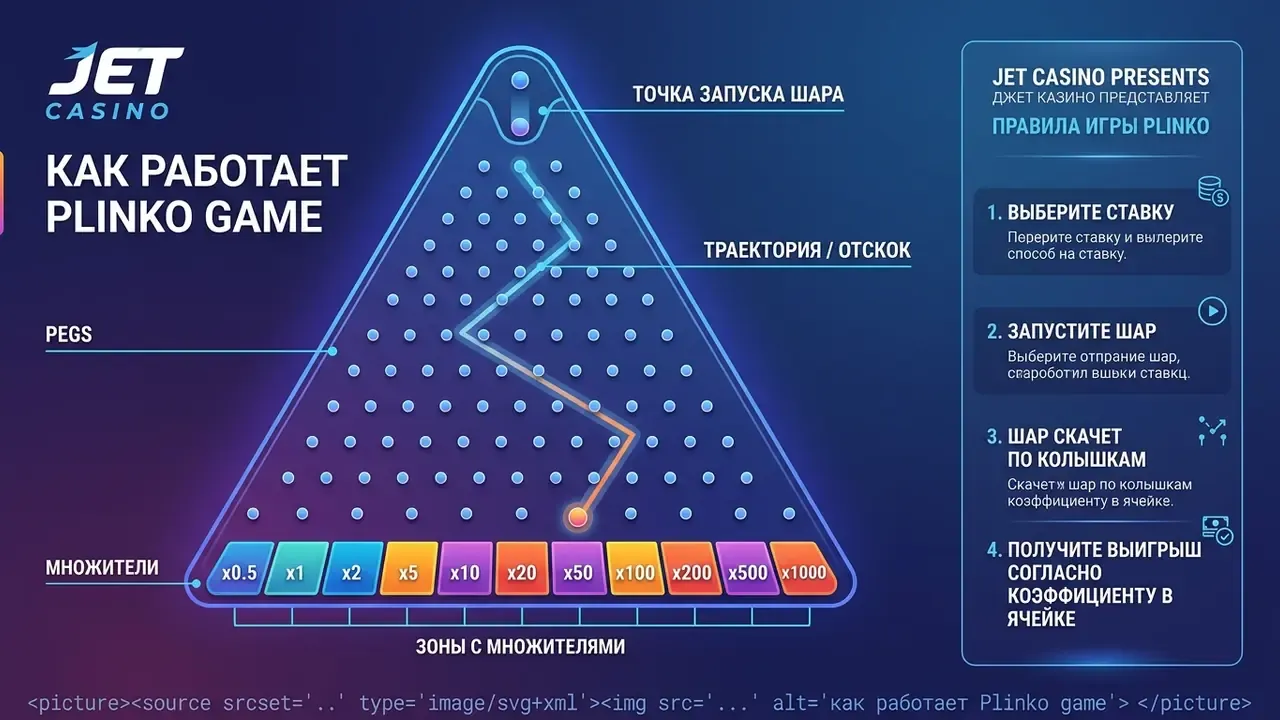
Plinko is a casual, physics-styled ball-drop game. A ball is released above a triangular grid of pegs, deflects left or right at every peg, and finally settles into one of the multiplier slots at the bottom of the board. Your payout is simply the stake multiplied by the value of the slot the ball lands in.

No reels, no paylines, no wilds, no scatters. Just a probability funnel, a paytable, and the settings you choose before each drop.

Three studios dominate the category, and each of them builds the same idea differently: BGaming (RTP up to 99%, max 1,000x, 8–16 lines, record table), Spribe (RTP 97%, max 555x, 12/14/16 rows, three coloured risk buttons) and Nyx (RTP around 96%, max 700x total bet, with Multiballs, Pushers and Cash Prizes). This guide covers all three, adds the exact probability mathematics of the board, explains how to verify a provably fair round yourself, and clarifies where real-money and sweepstakes play are legally available.

Table of ContentCloseOpen
Why This Matters If You Play

Why This Matters If You Play From Canada

A Plinko game looks identical on every site. The terms around it do not. Two operators can run the same BGaming build, publish two different RTP figures, hold two different licences, and pay you out on two very different timelines.

For a Canadian player the practical questions are narrow. Is the site legal in my province? Are stakes and balances handled in CAD, or will a currency conversion quietly shave a few percent off every deposit and withdrawal? Can I fund the account with Interac e-Transfer or an e-wallet, and how long does the first cashout actually take once verification kicks in? Provincially operated platforms (iGaming Ontario registrants, BCLC's PlayNow, Loto-Québec's Espacejeux, ALC in Atlantic Canada) sit inside a clear regulatory frame.

Offshore sites licensed in Malta or Curaçao can be perfectly reasonable, but the dispute route is different and worth understanding before money moves.

Minimum age is 19 in most provinces, 18 in Alberta, Manitoba and Quebec. That is not a formality; it is the first thing verification checks.

"In my review routine, the number I look at first is not the maximum multiplier," says Reid Calloway, independent online-casino analyst. "It is what the three centre slots pay, because that is where most of your drops end up."

What Plinko Is and How the Game Mechanic Works

Plinko is a direct descendant of the Galton board, a device introduced by Francis Galton in the late 19th century to visualise how many small independent random events accumulate into a bell-shaped distribution. The board's outcome is not aimed at a target slot; it is produced by a chain of binary deflections. The online version reproduces exactly that logic in a digital interface, which is why the game is simultaneously trivial to understand and mathematically rich.

Ball drop, peg grid, and outcome formation

A single release point sits at the top centre of the pyramid. As the ball falls, it strikes each row of pegs and bounces randomly left or right, functionally a coin flip at every row. After passing through all rows, it lands in one of the bottom slots. A board with n rows produces n + 1 landing slots: 8 rows give 9 slots, 16 rows give 17 slots.

Because the same starting point produces a different trajectory every time, the distribution of landing positions is path-dependent rather than fixed, approximating the normal distribution when the number of rows is sufficiently large.

«With 16 rows, the chance of reaching the outermost slot is roughly 1 in 65,536, a textbook demonstration of the binomial distribution.» Source: GamblingCalc, Plinko Odds & Probability Explainer (2026)

Run enough drops and the shape becomes visible on screen, demonstrating convergence to the binomial distribution as the number of balls grows.

«Empirically, the mean and standard deviation of the drop distribution converge to np and √(np(1−p)) as the number of balls increases.» Source: Galton Board Simulator, educational probability tool (2025)

How the ball path translates into multipliers

The bottom of the board is a fixed paytable. Slots near the centre carry small multipliers (often below 1x on high-risk settings), while the outer slots carry the largest ones. The multiplier ladder is not arbitrary: it is calibrated so that the weighted sum of probability × multiplier produces the studio's target RTP.

Crucially, the same Plinko engine can be shipped at different return rates. Operators frequently configure the payout tables they license, which illustrates that one game logic can be parameterised at several payout rates depending on the host operator's setup.

«The same Hacksaw Gaming title returns 98.98% at one casino and 96.00% at another.» Source: CryptoSlate, Plinko Casino Benchmark (2026), cryptoslate.com

That is why "Plinko RTP" is never a single number. It is a property of the specific build running on the specific site you are logged into.

Differences between Plinko and traditional slot

Differences between Plinko and traditional slot games

In classic slots, the outcome is driven by reel-stop combinations on paylines, and the reel strips stay hidden behind a spin animation. In Plinko, the outcome model is exposed. You see the grid, the number of rows, the risk profile and the full multiplier ladder before you commit a stake. The player controls volatility directly instead of inheriting it from a hidden math model.

Perception differs too. Slots deliver a rapid spin-and-reveal cycle; Plinko delivers a visible descent with mounting anticipation, which many players read as "physical" rather than algorithmic. Plinko often appears alongside slots in online casino lobbies, but it belongs to the instant / casual category, typically with no free spins, no bonus buy and no gamble feature. The absence of bonus mechanics is both its charm and its limitation: everything is up front, and nothing is being withheld to be "triggered" later.

Plinko by Provider: Full Comparison Table

ParameterBGaming PlinkoSpribe Plinko ClassicNyx Plinko (e.g. BetMGM)
RTPup to 99%97%~96% (varies by jurisdiction)
Max multiplier1,000x555x700x of total bet
Rows / pins8–16 lines12, 14 or 16 rowsdynamic board, refreshes each round
Risk levelsLow / Normal / HighGreen (low) / Yellow (medium) / Red (high)configurable via features
Special featuresRecord table of results, Manual & Auto betthree coloured launch buttons, AutoplayMultiballs, Pushers, Cash Prizes, Refresh, Autoplay
Bet rangeoperator-dependentoperator-dependent$0.10–$20 (BetMGM build)
Release / typeCasual, since Jan 2019Casual / arcadeInstant game
Demo modeYesYesLimited (jurisdiction-dependent)
How to read this table. BGaming's

How to read this table. BGaming's 99% RTP is the headline figure of the category, and its max win of 1,000x is reached on the widest board at high risk. Spribe caps out at 555x, a frequently misquoted number, so treat any page claiming "1,000x on Spribe" as unreliable. Nyx trades raw multiplier ceiling for feature depth.

Nyx feature mechanics explained:

  • Multiballs (up to 1 per round): splits or duplicates the drop, so a single stake can produce more than one landing outcome.
  • Pushers (up to 5): obstacles placed on the board that nudge the ball's trajectory, deliberately distorting the "clean" binomial spread.
  • Cash Prizes (up to 5): fixed cash pockets seeded into the bucket row, giving flat rewards independent of the multiplier ladder.
  • Refresh: regenerates features and bucket values before you start, letting you accept or reject a board layout.

One practical note. Feature-heavy boards are harder to price mentally, because a Pusher breaks the tidy left/right symmetry the math assumes. If you want to reason about your odds, the plain 16-row board is easier to read.

The Math of Plinko Binomial Distribution

The Math of Plinko: Binomial Distribution and the Bell Curve

Each peg gives the ball a 50/50 chance of going left or right. That makes the descent a sequence of independent Bernoulli trials, and the final horizontal position follows a binomial distribution, the same distribution that governs the number of heads in a series of coin flips.

For a board with n rows there are n + 1 landing slots, and the probability of landing in slot k (counting from 0) is:

P(k) = C(n, k) / 2ⁿ = n! / [ k!(n−k)! · 2ⁿ ]

where C(n, k) is "n choose k", the number of distinct paths through the pegs that terminate in slot k. The formula produces the familiar bell curve: most outcomes cluster near the centre, with exponentially fewer at the extremes.

On a 16-row board, reaching the outermost slot requires the ball to deflect in the same direction at all 16 pegs. The probability is 1 / 2¹⁶ = 1 / 65,536 ≈ 0.0015%. The enormous edge multipliers exist precisely to compensate for that rarity.

Probability and payout distribution: high risk, 16 rows

Landing zoneMultiplierApprox. probability
Far edge (slot 1 or 17)1,000x~0.0015% per side
Near edge (slot 2 or 16)263.4x~0.024% per side
Outer (slot 3 or 15)56.7x~0.18% per side
Mid-outer (slot 4 or 14)9.5x~0.85% per side
Mid (slot 5 or 13)1.4x~2.78% per side
Inner-mid (slot 6 or 12)0.5x~6.66% per side
Inner (slot 7 or 11)0.4x~12.22% per side
Near centre (slot 8 or 10)0.4x~17.46% per side
Centre (slot 9)0.4x~19.64%

The three central slots alone absorb roughly 56.7% of all drops at 0.4x. Put plainly: on high risk, the overwhelmingly likely outcome of any individual drop is losing 60% of the stake, punctuated by extremely rare payouts of hundreds or a thousand times the bet.

Expected value and house edge. Expected

Expected value and house edge

Expected value is the average return per drop across a very large sample:

E = Σ pᵢ · mᵢ

where pᵢ is the probability of slot i and mᵢ its multiplier. On virtually every published configuration, E sits slightly below 1.0x. If E = 0.97x, you would expect to lose about 3% of total turnover over thousands of drops. That gap is the house edge, and it is unaffected by which risk level or row count you choose. Those settings redistribute variance, not expectation.

A quick illustration in CAD. Stake $1 per drop, 20 drops a minute, 30 minutes of autoplay: that is $600 of turnover. At 97% RTP the expected cost of that half hour is about $18, with a very wide spread around it. The edge is small per drop and heavy per session.

What rows and risk actually change

What rows and risk actually change

  • Row count (8–16). More rows mean more bounces, a wider board and greater dispersion. Fewer rows cluster outcomes tightly around the centre; more rows make extreme outcomes marginally reachable while sharply raising the value of edge slots.
  • Low risk. Centre-weighted distribution, most drops returning roughly 0.5x to 3x. Suited to long, low-variance sessions where the balance decays slowly.
  • Medium risk. A balanced spread: larger edge multipliers (commonly up to 55x–118x on Spribe's yellow ball) with still-frequent small centre wins.
  • High risk. Centre slots pay 0.2x to 0.5x; edges reach 555x (Spribe) or 1,000x (BGaming). Maximum variance, longest dry spells, biggest single-drop potential.

How to Play Plinko Online: Step by Step

1
Open the game in demo mode first. Load the free Plinko demo in your browser. HTML5 builds run without downloads or registration on desktop and mobile alike.
2
Set your stake per drop. Use the bet controls at the bottom of the interface. On the BetMGM/Nyx build, the range is $0.10 to $20; other operators define their own min and max.
3
Choose the row count. BGaming allows 8–16 lines; Spribe allows 12, 14 or 16. Start at 8–10 rows to keep variance low while you learn.
4
Select the risk level. Low/Normal/High on BGaming; green, yellow and red buttons on Spribe. On Nyx, configure Multiballs, Cash Prizes and Pushers, then press Refresh to regenerate the board before you commit.
5
Open the paytable and read the multiplier ladder. Confirm exactly what the centre slots pay. This is where most of your drops will land.
6
Drop the ball. In Manual mode you release each ball individually, and the animation shows every deflection in real time.
7
Collect the payout. Stake × slot multiplier is credited instantly. Every drop lands somewhere, so there is no "miss", but many landings return less than the stake.
8
Optionally enable Auto or Auto Drop. Autoplay releases balls back-to-back at a set interval. It is the fastest way to watch the bell curve form, and also the fastest way to burn a bankroll, so set a round limit before starting.
Stake size, number of balls, and

Stake size, number of balls, and launch mode

Two settings decide how quickly money moves: the stake per drop and the number of balls you release. Manual mode is one ball, one decision, one result. Autoplay converts that into a stream, often 25, 50 or 100 balls in a block, and the pause between drops can fall under two seconds.

Multiply before you launch. A $2 stake across a 100-ball autoplay block is $200 of turnover committed in roughly three minutes. If that figure feels uncomfortable written down, it was the wrong setting. Check the number of balls, the stake, and the selected risk profile on screen before the first release, not after the block ends.

Rows and risk level: what the settings really change

Rows widen the board; risk reshapes the paytable across it. Low risk on 8 rows keeps almost every result within touching distance of your stake, which makes the session long and the swings mild. High risk on 16 rows does the opposite: it drains the centre to 0.2x–0.5x and loads the far pockets with the headline multipliers.

Neither setting improves your expected return. They change the road, not the destination.

Plinko Demo and Free Plinko Testing

Plinko Demo and Free Plinko: Testing the Game Without Risk

A demo build uses virtual credits, cannot pay out real money, and exists so you can learn the mechanics, interface and pace before any deposit. Three things get conflated constantly, so let us separate them:
  • Free demo:play money only, no cash outcome, no registration in most cases.
  • Test balance:a non-cash balance used to verify gameplay and account flows on a platform.
  • No-deposit bonus:real promotional funds credited without a deposit, but bound by wagering, win caps and withdrawal conditions. This is not free play money.

Demo RTP and paytables normally mirror the real-money build, and reputable studios typically maintain the same parameters. There is no published, verifiable evidence that mainstream studios ship different RTPs to demo and cash builds. The technical possibility exists at the operator-configuration layer, but confirming it requires the game's own info panel or the studio's certification documentation. Treat any claim about "rigged demos" as unsupported until you can read those figures yourself.

Regulatory scrutiny of how games and promotions are presented is real and ongoing:

«The Gambling Commission completed 58 "fair and open" website reviews, finding 27 compliant and identifying minor issues in 24, many related to promotional bonus offer terms.» Source: UK Gambling Commission, Annual Report (2024)

What you can check in the

What you can check in the Plinko demo

Ten things worth testing before you deposit a dollar: the stated RTP; volatility behaviour at each risk level; minimum and maximum bet; the full payout table per risk level; the presence of any bonus mechanics; round speed; autoplay controls and limits; mobile and desktop rendering plus touch controls; independence of consecutive outcomes; and the operator's cashout rules for the equivalent cash build.

Do it methodically. Run 8 rows on low risk for 100 drops, then 16 rows on high risk for another 100, and compare how the balance line behaves. The second configuration usually looks flat, then flat, then suddenly not flat. That pattern is the point.

Try it without risk. Run at least 200 to 300 demo drops across two configurations, 8 rows on low risk and 16 rows on high risk, before deciding whether real-money Plinko fits your tolerance for variance.

Plinko mobile can you play without

Plinko mobile: can you play without a download?

Yes. Mainstream Plinko builds are HTML5 and load straight in Chrome, Safari or Firefox, so no Plinko download is required and no app install is involved. The board scales to portrait screens, the stake and risk controls sit within thumb reach, and autoplay is usually a single toggle, which is exactly why it deserves a limit.

Two mobile-specific cautions. First, a shaky connection can leave a drop resolved on the server while the animation stalls on your screen; check bet history rather than replaying. Second, be sceptical of any "Plinko app" that asks you to install a file from outside the official app stores. Provincially regulated Canadian platforms and licensed offshore operators both work fine in-browser.

Multipliers, Payout, and Risk in Plinko

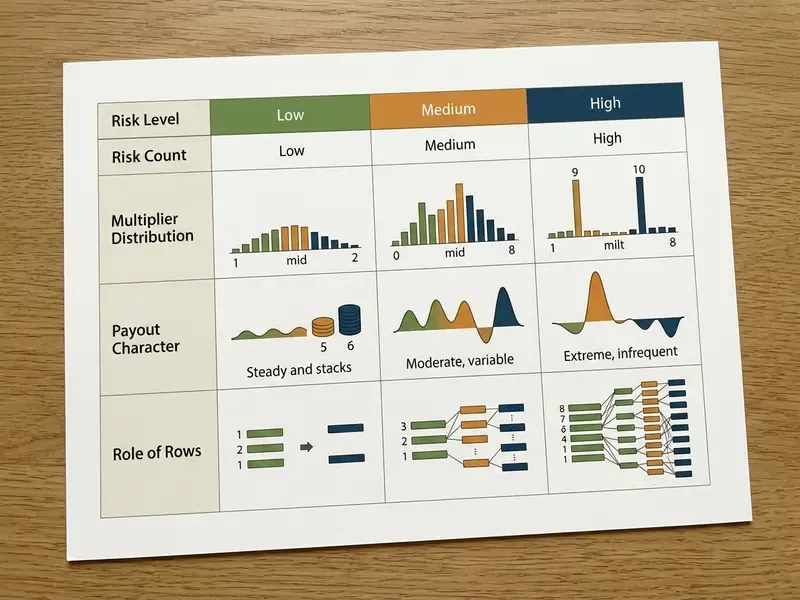
The multiplier table is the whole economy of the game. Centre pockets pay often and pay little; edge pockets pay rarely and pay heavily. Rows decide how many pockets exist, risk decides how the value is spread across them, and the number of balls decides how fast you sample that spread.

Risk levelCentre payout rangeEdge multipliersSession character
Low~0.5x–1.1xup to ~8x–16xLong, gentle, slow bankroll decay
Medium~0.3x–0.7xup to ~55x–118xBalanced, occasional real spikes
High~0.2x–0.5xup to 555x (Spribe) or 1,000x (BGaming)Long dry spells, rare large hits

Read the table as a variance dial, not a value dial. Low risk gives you more drops per dollar and almost no chance of a headline win. High risk gives you a lottery ticket funded by steady 0.4x returns. The expected loss per dollar staked stays roughly the same in both columns, because the paytable was calibrated that way.

Why a high multiplier lands so rarely

Geometry. The biggest multipliers sit in the outermost pockets, and only one path out of 2ⁿ reaches each of them. On 16 rows that is one path in 65,536 for each far edge, while the centre pocket is reached by 12,870 different paths. The ball does not "aim"; it accumulates 16 coin flips, and coin flips cluster.

This is why streaks feel meaningful and are not. A run of centre landings does not make an edge landing "due", because each bounce forgets everything that came before it.

Real-Money Plinko: Casino Selection, RTP, and Fairness

This section is general information, not professional advice. The availability of real-money games depends on the legislation of your province or country.

How to assess a Plinko casino

How to assess a Plinko casino before you deposit

Plinko is distributed across hundreds of sites, and the published RTP varies materially between them. That puts the work on the player: find the RTP table, the fairness documentation and the licensing details before funding an account. If you want the wider industry context behind how these builds are licensed and configured, our iGaming hub covers the supply chain from studio to operator, and our guide to casino payment methods in Canada covers Interac and e-wallet timelines in CAD.

A separate RTP and payout comparison from BTCGOSU lists specific values across crypto-facing operators, and the numbers need careful reading. Gamdom is advertised at up to 100% RTP with a 1,000x maximum multiplier, a figure that can only hold under specific promotional or rakeback conditions and should be verified in the game's own info panel before it is taken at face value. BetFury is listed at roughly 99.02% RTP with a maximum multiplier of 100,000x, and BC.Game at 98% RTP with a headline maximum of 1,000,000x. That last ceiling is a theoretical cap on a heavily customised board, not a realistically attainable outcome, and it is published without independent verification methodology.

«Plinko is an RNG game; the ball's path is determined by a provably fair algorithm, and no betting system changes the house edge.» Source: BTCGOSU, Plinko RTP and Payout Comparison (2025), btcgosu.com

«Across 45 published bets at six crypto casinos, measured Plinko RTP ranged from 94.19% to 99.16%.» Source: CryptoSlate, Plinko Casino Benchmark (2026), cryptoslate.com

Reliability checklist for a Plinko casino:

Jet Casino heading-banner
  • Licence:a named regulator (AGCO / iGaming Ontario, a provincial lottery corporation, MGA, UKGC, Curaçao), a licence number, and the licensee entity disclosed in the footer or terms.
  • Official provider integration:Spribe, BGaming or Nyx listed on the operator's own provider page. A Plinko "skin" without a named studio is a red flag.
  • Provably fair or certified RNG:a working verification tool, or a testing-lab certificate (iTech Labs, eCOGRA) tied to the specific build and operator. Certificates do not transfer to third-party clones.
  • Payout transparency:published withdrawal methods, CAD limits, processing windows, KYC/AML conditions and fee rules.
  • Displayed RTP:visible in the game info panel, not only in marketing copy.

Provably fair algorithms and how to verify a Plinko round

Provably fair systems precommit to a cryptographic seed before the round, then let the player reconstruct the outcome afterwards. Any mismatch is evidence of tampering or of sloppy documentation.

«An algorithm qualifies as provably fair only if it is deterministic, derives outcomes from a keyed hash of both seeds, and is publicly documented before the round begins.» Source: Provably Fair Algorithm Whitepaper (2025)

Verification, step by step 1. Open

Verification, step by step:

  1. Open the fairness menu and copy the Server Seed (generated and hash-committed by the casino before play) and the Client Seed (generated by your browser, and editable by you on most platforms).
  2. Note the Nonce, the sequential number of the drop within the current seed pair.
  3. Reproduce the hash: SHA-256(Server Seed : Client Seed : Nonce) or, on HMAC-based implementations, HMAC_SHA256(Server Seed, Client Seed:Nonce).
  4. Map the output to bounces: successive byte pairs of the hash are converted into floats, and each float decides one left/right deflection, so 16 floats for a 16-row board.
  5. Compare the reconstructed landing slot with the slot shown in your bet history, and verify that the pre-round hashed server seed matches the revealed server seed. Because the seed was committed before you dropped the ball, the result cannot be altered mid-round.

If any of the four inputs (hashed commitment, revealed server seed, client seed, nonce) is missing from the interface, the game is not verifiable in practice, whatever the marketing says.

Regulatory perspective on online RNG and consumer fairness

Regulated markets certify RNG behaviour through independent labs, while crypto-native operators lean on cryptographic verifiability. The most robust builds do both, combining traditional lab testing with provably fair reconstruction.

«Use a GLI-19-certified hardware RNG or AES-CTR-DRBG as the source of the server seed in a hybrid provably fair architecture.» Source: Engineering Guide to Provably Fair RNG in Node.js (2026)

Regulators also constrain how the product may be described. Operators must present safer-gambling information, must not imply that gambling is a way to make money, and must disclose that outcomes are chance-based and that players can lose more than they win. In Ontario, marketing rules go further and restrict how bonuses may be promoted to players who have not opted in.

Legal status where and how to
  • Real-money casinos. Available in jurisdictions with recognised licensing regimes: iGaming Ontario registrants, provincial platforms such as PlayNow, Espacejeux and ALC, plus MGA, UKGC and Curaçao licensees. Requires a deposit in real currency and full KYC.
  • Sweepstakes / social casinos (US, parts of Canada). These run a dual-currency model: Gold Coins for pure free play with no cash value, and Sweeps Coins that can be redeemed for cash prizes or gift cards under the promotional terms. The model exists because real-money online casino play is restricted in most US states.
  • Demo-only access. In markets where neither model is licensed, free Plinko demos remain the only lawful way to experience the mechanic, with the explicit understanding that demo results do not reflect real-money outcomes.

Always confirm the operator's list of accepted jurisdictions and the minimum age (19+ in most Canadian provinces, 18+ in Alberta, Manitoba and Quebec, 18+ or 21+ elsewhere) before registering.

This information is general in nature and does not replace consultation with a qualified specialist. If you are struggling to control your gambling, seek professional help: ConnexOntario (1-866-531-2600) in Ontario, your provincial support line elsewhere in Canada, or the National Problem Gambling Helpline in the US (1-800-GAMBLER).

Structural changes in online gambling ecosystems

Online gambling has shifted from discrete betting events toward continuous, always-available products. Peer-reviewed work on these structural changes documents harmful behaviours such as impaired control, irrational decisions, impulsive gambling, increased emotional involvement, and illusions of control.

«Problem gambling prevalence among in-play bettors is three to four times higher than among those who do not bet in real time.» Source: peer-reviewed study on structural changes in online gambling (2022–2023)

Plinko sits squarely in the continuous-play category. A round lasts seconds, autoplay removes the decision point entirely, and the visible ball trajectory encourages an illusion of influence over a purely random path.

Speed of play, constant action, and loss-chasing

Round duration is a harm variable in its own right, because higher bet frequency multiplies exposure to the house edge and shortens cooling-off periods. A 3% edge applied to 20 drops per minute compounds far faster than the same edge applied to a handful of slower wagers.

«Calls to the problem gambling hotline in Massachusetts rose by more than 120% in the first year after online betting was legalised.» Source: testimony to the US Senate Judiciary Committee (December 2024)

The financial consequences are measurable at population level, which suggests that ease of access amplifies financial harm.

«Research from UCLA/USC and Northwestern documents nearly a 30% increase in bankruptcy filings in states that legalised online sports betting.» Source: testimony to the US Senate Judiciary Committee (December 2024)

Accessibility, impulsivity, and loss of control in continuous-play games

A game that is one tap away at any hour removes the natural friction that used to bound a session, which raises the likelihood of extended, harmful play.

«Participants reported that instant, round-the-clock access to online gambling triggered impulsive, prolonged sessions with high expenditure.» Source: peer-reviewed study on structural changes in online gambling (2022–2023)

Practical countermeasures: set a deposit limit before you play rather than mid-session; disable autoplay; switch on reality-check reminders; and never treat a high RTP figure as a reason to extend a session, because 99% RTP still means expected loss.

SAFE Bet Act and emerging policy responses

Legislative responses increasingly target product design rather than advertising alone, including restrictions on push promotions and bans on proposition bets on college sports to protect younger athletes and fans.

«The SAFE Bet Act proposes affordability checks, deposit limits, and restrictions on micro-betting to reduce systemic harm.» Source: testimony to the US Senate Judiciary Committee (December 2024)

Micro-betting limits are directly relevant to Plinko-style products, whose economics depend on very high round frequency at small stakes.

Plinko Strategy: Managing Stakes and Expectations

Why no betting system can beat

Why no betting system can beat the house edge

Martingale, reverse Martingale, fixed-percentage staking and progressive ladders all change the shape of your bankroll curve, not its expected endpoint. Each drop remains an independent trial with fixed probabilities and multipliers, no matter how stake size varies between rounds.

Formally: if E = Σ pᵢ · mᵢ < 1 for a single unit staked, then E for any linear combination of stakes across independent rounds is also below 1. No sequencing rule turns a negative expectation into a positive one. It only redistributes when losses occur and how large they are.

What is legitimate is variance management:

  • Low-risk bankroll preservation. Choose 8–10 rows on low risk, where the worst centre outcomes are typically 0.5x–0.8x rather than 0.2x–0.4x. Cap autoplay at 100 drops per block and reassess. On a 99% RTP build this configuration produces the longest playable session per dollar of bankroll, though the expectation stays negative, so treat the spend as entertainment cost rather than investment.
  • High-risk targeted sessions. If you want the 555x or 1,000x lottery, size stakes so that a full 100-drop block of centre landings is affordable. Statistically, that block is the expected outcome, not bad luck.
  • Fixed session budget and stop-loss. Decide the loss you accept before the first drop, write it down, and do not top up.
  • Never chase. Raising stake size after a losing streak is the single most documented pathway from recreational play to harm.

Why a strategy cannot guarantee a win

Because the drop is random and memoryless. Staking rules change your exposure per round; they do not change the probability attached to any pocket. A 16-row high-risk board will hand you long stretches of 0.4x returns regardless of whether you flat bet, double after losses, or drop one ball an hour. Read every "guaranteed Plinko strategy" claim as a marketing sentence, not a mathematical one.

How to test settings before real-money

How to test settings before real-money play

Use the demo as a lab, not a warm-up. A workable sequence: fix a notional bankroll of 500 units; run 100 drops at 8 rows on low risk and record the ending balance; repeat at 12 rows on medium; repeat at 16 rows on high. Keep the number of balls identical across the three blocks so the comparison means something.

You are not looking for a winning configuration. You are looking for the drawdown you can watch without flinching. Once that is clear, move to real money at the smallest available stake, keep autoplay off for the first session, and confirm the withdrawal path with a small cashout before you increase anything.

Fact-check checklist for evaluating a specific

Fact-check checklist for evaluating a specific Plinko game

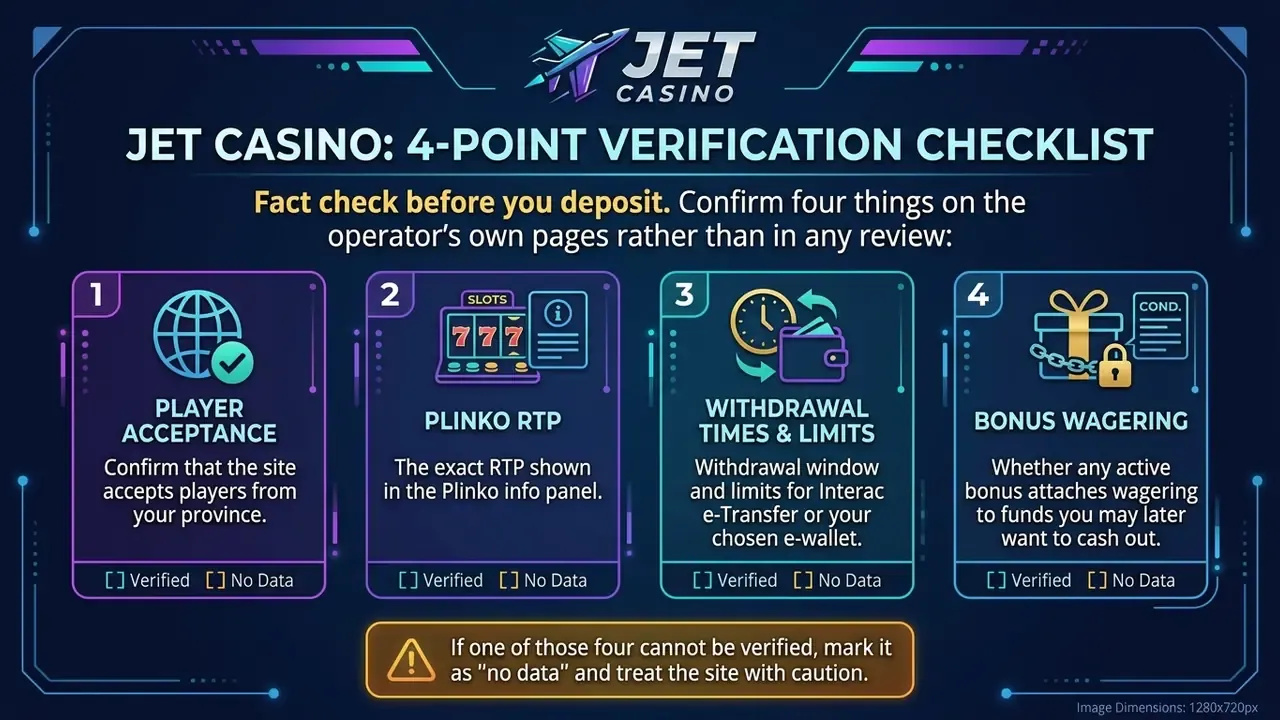
Before staking real money on any build, confirm each of the following in the game's own interface, not in a review:

  1. Studio name (BGaming, Spribe, Nyx or other) shown in the info panel.
  2. Stated RTP for that operator's configuration. The same title can be shipped at different rates, so take this from the info panel or fairness documentation.
  3. Maximum multiplier: 1,000x (BGaming), 555x (Spribe), 700x of total bet (Nyx). Any other headline number needs a source.
  4. Full multiplier ladder for every risk level and row count you intend to use.
  5. Min and max bet, and whether limits change between risk levels.
  6. Provably fair tooling: hashed server seed, revealed server seed, editable client seed, visible nonce.
  7. Lab certification: an iTech Labs or eCOGRA certificate naming this build and this operator.
  8. Licence and jurisdiction, plus whether your region is served under a real-money or sweepstakes model.
  9. Responsible-gambling tools: deposit limits, session timers, self-exclusion.
  10. Withdrawal terms: processing windows, CAD limits, KYC triggers, and any bonus wagering that could lock winnings.

Verified vs contested facts at a glance:

ClaimStatus
BGaming Plinko RTP is 99%Supported (studio game details)
Spribe Plinko Classic RTP is 97%Supported
Spribe maximum multiplier is 1,000xContradicted. Spribe caps at 555x (16 rows, red); 1,000x belongs to BGaming and to free social builds
Probability of the outer slot on 16 rows ≈ 0.0015%Supported (1 / 2¹⁶ = 1 / 65,536)
Nyx Plinko includes a Pushers featureSupported (BetMGM game description)
Nyx maximum payout is 700x of total betSupported
"100% RTP" Plinko buildsAdvertised, conditional. Verify in-game before accepting

FAQ: Common Questions About the Plinko Game

Appendix A Glossary and Pre-Play Checklist

Appendix A: Glossary and Pre-Play Checklist

Glossary
  • Peg / pin:an obstacle that deflects the ball left or right.
  • Row / line:one horizontal layer of pegs; n rows produce n + 1 slots.
  • Slot / bucket / pocket:a landing position with an assigned multiplier.
  • Risk level:the paytable profile (Low/Normal/High, or green/yellow/red) that redistributes multipliers between centre and edges.
  • RTP:theoretical long-run return to player, Σ pᵢ · mᵢ expressed as a percentage.
  • House edge:100% minus RTP.
  • Variance / volatility:dispersion of outcomes around the expected value.
  • Provably fair:a deterministic, publicly documented scheme letting the player reconstruct each result from precommitted seeds.
  • Server seed / client seed / nonce:the three inputs to the outcome hash.
  • Multiball / Pusher / Cash Prize:Nyx-specific board modifiers that add extra balls, deflecting obstacles, or fixed cash pockets.
  • Gold Coins / Sweeps Coins:the dual-currency model used by sweepstakes casinos.

Pre-play checklist

☐ Licence and jurisdiction verified ☐ Studio identified ☐ RTP read in-game ☐ Full multiplier ladder reviewed ☐ Provably fair tool tested on one round ☐ CAD deposit limit set ☐ Session stop-loss written down ☐ Autoplay capped or disabled ☐ Withdrawal terms and Interac timelines read ☐ 200+ demo drops completed first

Compare on the facts, read the terms before you deposit, and treat the budget as the price of entertainment. If the checklist above is complete, you are making an informed choice, which is the only edge a player genuinely controls.

Responsible gambling notice: Plinko is a chance-based entertainment product, not a source of income. Winnings are never guaranteed and you can lose your entire stake. Play only with money you can afford to lose. 19+ in most Canadian provinces, 18+ in Alberta, Manitoba and Quebec, 21+ in some other jurisdictions. If gambling stops being fun, use deposit limits and self-exclusion tools, or contact a licensed support service.